One of the most surprising and difficult adjustments for a new missionary are the rules surrounding phone usage. As someone who had been very much accustomed to having full control over my own device, I was not happy to learn these in the field. Still, as with all adjustments, I got used to them and even came to appreciate them . . . eventually. So, save yourself the surprise by reviewing these now, before your mission, so that you can know what to expect.
MAAS
“MAAS” refers to the system that the church uses to restrict phones. When I served, missionaries were expected to provide their own phones, and each phone was supposed to get a MAAS makeover early on in its service. Now, the Church provides missionaries with phones, so they come pre-loaded with MAAS.
The most obvious thing that MAAS does is prevent missionaries from accessing the Internet – except for the Church website. It also blocks suspicious and graphic content. Lastly, it prevents you from downloading most apps.
I knew a few missionaries who “got around MAAS” somehow to access the Internet, but I genuinely don’t know how they did it, nor would I like to know. MAAS, though annoying, is a good thing.
One SIM Card
This one is less of a rule and more of a fact. Each missionary companionship shares one SIM card between them. Typically, the senior companion gets to keep the SIM card in their phone, and the junior companion’s phone is treated more like a tablet. The SIM-card-less companion can use their phone when there’s wifi available, or when the senior companion turns on the hotspot.
When I was the junior companion, I was able to access WIFI by logging into my family’s Xfinity hotspot. Highly recommend writing down those credentials before your mission starts if you have access to them:)
Four Eyes, One Screen
The general “golden rule” when it comes to phone rules for missionaries for the Church of Jesus Christ of Latter-Day Saints is to always have four eyes on one screen. That means that only one phone is used within the companionship at a time, and both companions are actively looking at the same screen at the same time.
There are a few exceptions to this rule. One is personal study, when each missionary can be on their own phone to look up talks and other study materials. The second is Preparation Day (more on this in the last section).
Sending Messages
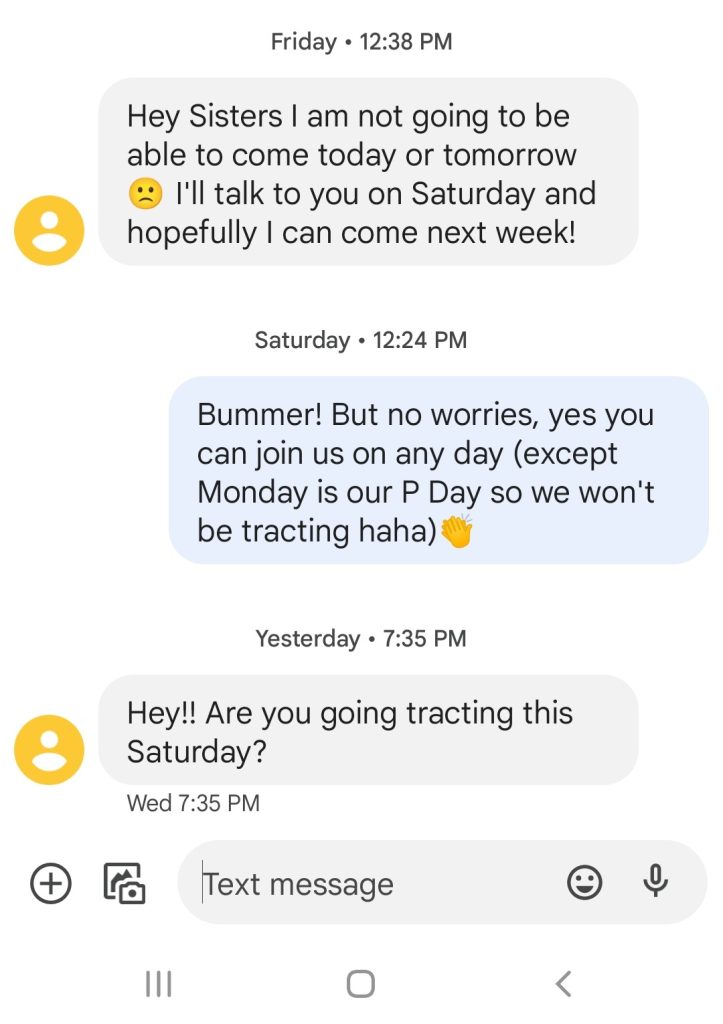
Every message sent (except for P Day communication with friends and family) must be explicitly approved by both members of the companionship. In my mission, the default phrase was “Can I send this?” For example, if the companionship is working on finding people to teach through social media, the missionary holding the phone might type a message to someone on Facebook like, “I see a lot of Jesus quotes on your feed, which one is your favorite?” Then he/she would ask, “Can I send this?” and wait for approval from their companion.
No Phones Behind Closed Doors
Basically, you can never be alone with your phone (unless talking to family). Since you’re never alone anyways, this rule is really just don’t take your phone with you into the bathroom. Missionaries will usually just leave their bags outside their bathroom stall.
Announce Your Purpose
Even though four eyes are typically on one screen, the person holding and maneuvering the phone is expected to “announce their purpose” whenever it’s used. This means verbally announcing what you’re doing with the phone as you’re doing it. This rule can take many forms, but in my mission, we typically stated which app we were opening. For example, a missionary turning on the phone to confirm that day’s dinner appointment would announce “I’m opening messages” (or, just “messages”).
Communicating with Other Missionaries
To communicate with other missionaries, the companionship initiating the communication is supposed to make a group chat (typically over Facebook messenger) with their companion, both members of the other companionship, and themselves. Basically, there is no digital missionary communication with less than four members in the chat.
Scrolling
“Scrolling”, or sitting and consuming social media, is generally discouraged – even during breaks. Some social media is consumed during social media finding, like examining someone’s profile before messaging them, but it’s minimal.
Preparation Day
Preparation Day is the only time when phone rules are a bit different. The main exception is that missionaries are typically allowed to be alone when communicating with immediate family. Missionaries are also allowed to send letters to the Mission President without review or approval from their companion.
When writing emails and communicating with friends, rules vary significantly from mission to mission. In my mission, we were expected to have four eyes on one screen for most of P Day and when communicating with friends. Still, most missionaries didn’t want their companions eavesdropping on their personal lives. To circumvent this without breaking any rules, it was popular in my mission to send voice memos. That way, you could press record and walk away from your companion, since your screen isn’t actually on. Then you came back into the room where your companion is, turn your screen on, and click send. Thankfully, we didn’t need to ask, “Can I send that?”